Home/Lacrumae Divae Virginis et Joannis in Christum a cruce depositum (Tears of the Blessed Virgin and John at the Deposition of Christ from the Cross)
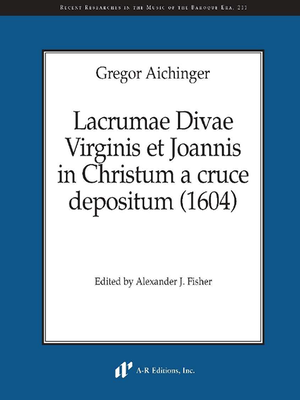
Lacrumae Divae Virginis et Joannis in Christum a cruce depositum (Tears of the Blessed Virgin and John at the Deposition of Christ from the Cross)
Score: Lacrumae Divae Virginis et Joannis in Christum a cruce depositum (Tears of the Blessed Virgin and John at the Deposition of Christ from the Cross) by Gregor Aichinger
Abstract: The Lacrumae Divae Virginis et Joannis in Christum a cruce depositum (Tears of the Blessed Virgin and John at the Deposition of Christ from the Cross) is a cycle of eight motets composed by Gregor Aichinger (1564–1628) and published at Augsburg in 1604. Setting the Latin poetry of the Augsburg patrician and humanist Marcus Welser, Aichinger composed these dialogues between Mary and John the Evangelist in the expressive language of the late Renaissance motet for an ensemble of five and six voices. The cycle is remarkable for its connection to a bronze sculptural group depicting Mary, John, and Mary Magdalene at the foot of the cross, executed by Hans Reichle and erected in the Benedictine basilica of SS. Ulrich and Afra—where Aichinger served as organist—in 1605, creating an aural-visual complex that encouraged viewers and listeners to meditate on the mysteries of the Crucifixion.
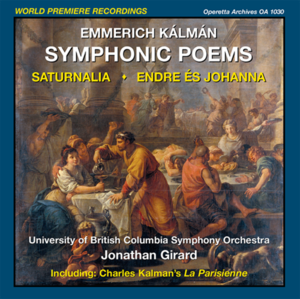
Performers: UBC Symphony Orchestra, UBC Opera Ensemble, Scott Rumble (MMus’18) and Elana Razlog (DMPS’16, MMus’17) Conductor: Jonathan Girard Music: Emmerich Kálmán and Charles Kálmán Recording details: Operetta Archives, November 2020 Link
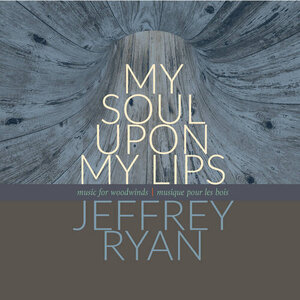
Composer: Jeffrey Ryan Featured UBC faculty performers: Adjunct Professor of Oboe Beth Orson, saxophonist and sessional lecturer Dr. Julia Nolan, and Professor of Piano Dr. Corey Hamm Featured tracks:
Beth Orson (oboe & English horn) in Quince
Corey Hamm (piano) in Arbutus Julia Nolan (alto saxophone) in Luminous Blue Recording details: Redshift Records, released October 30, 2020 Link
The School of Music is a leader in music scholarship, from music theory to ethnomusicology. Faculty contribute actively to music research and support students in developing their research interests.
Abstract: Chen Yi’s Ba Ban (1999) for solo piano, like many works of Western-trained Chinese composers, situates fragments of evocative traditional folk melody within a post-tonal discourse that is well described by transformation theory. The eponymous folk tune that it quotes is a standard of the sizhu (“silk-and-bamboo”) repertoire. In sizhu performance practice, the evenly pulsed rhythm of the 68-beat melody is augmented and each pitch is highly “flowered,” that is, decorated. Chen’s piece, often simulating the timbral quality of sizhu heterophony, reproduces some of the directed temporal qualities of this repertoire by quoting distinctive phrases and elaborating their pitches. Intermingled with this discourse, however, it presents multilinear threads of motivic transformation through virtuoso figurations typical of Western piano repertoire. The free rhythm evokes a different folk music tradition, mountain song, that Chen mentions as inspiration. At first, as the post-tonal structures are introduced, they disrupt the linear continuity of the Ba Ban folk tune and create an undirected associative network. Eventually, however, they gain control over temporality as firmly as Ba Ban did at first, and then Ba Ban itself is transformed into ametrical pulse. Considering the contrasting gendered connotations of mountain song and sizhu, I suggest how my narrative of these rhythmic processes might resonate with some ideas of feminist theory.
Publication details: A Companion to Music at the Habsburg Courts in the Sixteenth and Seventeenth Centuries, edited by Andrew W. Weaver, 467-98. Leiden: Brill, 2020